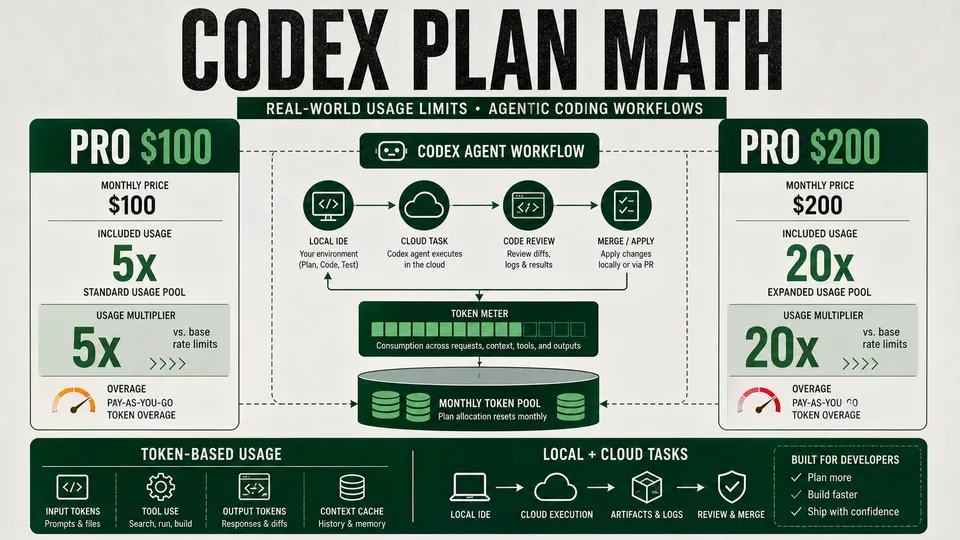
OpenAI's $100 Pro plan is the best Codex value for solo developers, and since 10 Sep 2026 the only Pro tier open to new buyers: $200 Pro is paused.
For most heavy solo developers, OpenAI’s ChatGPT Pro $100 plan is the better value right now — and as of 10 September 2026 it is also the only Pro tier a new buyer can get, because OpenAI has temporarily paused new sign-ups and upgrades to the ChatGPT Pro $200 plan. Developers who run Codex continuously across large repositories, cloud tasks, code reviews and parallel agent workflows still get more headroom on $200, but that is now a plan you can only keep, not a plan you can buy.
What the pause means in practice. OpenAI paused new Pro $200 (Pro 20x) subscriptions and upgrades on 10 September 2026, including upgrades from Free, Go, Plus or Pro $100, citing demand for GPT-6 Astra after its 3 September 2026 launch. Existing Pro $200 subscriptions continue to renew as usual, and new or existing Pro $100 subscriptions are unaffected. If a Pro $200 subscription ends — cancellation, downgrade, failed renewal or refund — it cannot be repurchased until the pause lifts. So the overflow path for a Pro $100 developer is no longer “upgrade to $200”; it is credits or an API key.
The comparison is not as simple as “twice the price, twice the coding.” Codex usage in ChatGPT plans depends on the plan, the model, task complexity, context size, whether work runs locally or in the cloud, and how much output the agent produces. OpenAI also counts Codex toward a broader agentic usage pool, alongside tools such as ChatGPT Work, ChatGPT for Excel and Workspace Agents where applicable.
Quick Summary
Codex is OpenAI’s coding agent for writing, reviewing and shipping software. It can run in local workflows such as the CLI, the IDE extension and the ChatGPT desktop app, and in cloud-based workflows such as delegated tasks, GitHub code review and Slack-connected development work. See how it stacks up against Claude Code, Antigravity CLI and OpenCode.
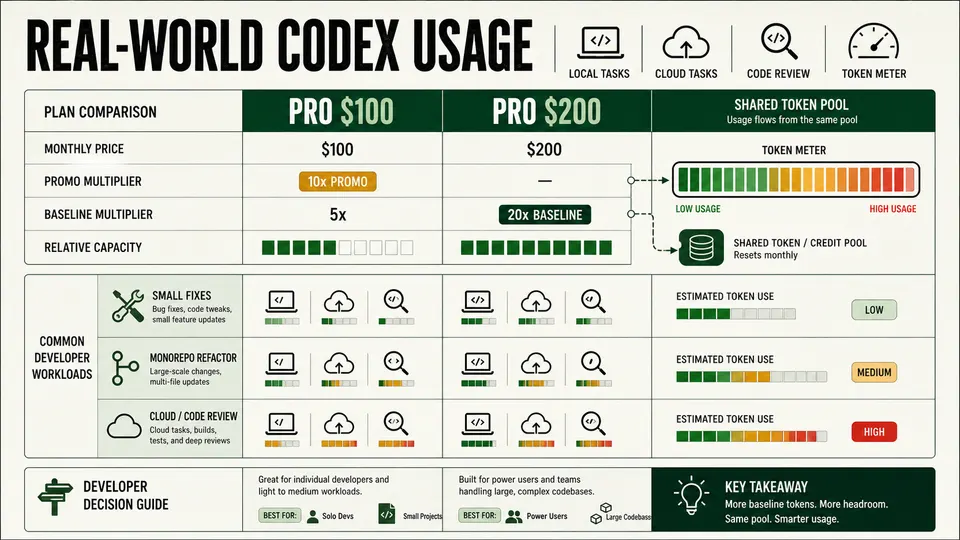
The key point for buyers: Codex limits are not fixed “hours of coding.” OpenAI publishes plan multipliers and per-model planning ranges, but actual consumption varies. A short function rewrite may use only a small slice of allowance. A long refactor in a large monorepo, with repeated test runs and extensive context, can consume far more.
At today’s prices and today’s availability, the choice looks like this:
- Pro $100 / Pro 5x: best value for serious solo developers doing regular coding, and the highest Pro tier open to new buyers.
- Pro $200 / Pro 20x: best for sustained, high-volume Codex use — but closed to new subscriptions and upgrades since 10 September 2026.
- Plus, credits, or an API key: better for casual users, and the practical overflow valve for anyone who outgrows 5x while the pause holds.
Plan Comparison: Pro $100 vs Pro $200
OpenAI describes the $100 Pro plan as Pro 5x. Its Codex allowance is five times the Plus tier. That is the steady-state number and the one to plan against.
The $200 Pro plan is Pro 20x, with 20 times the Plus allowance. OpenAI’s current Pro-tier guidance is unambiguous: Pro $100 unlocks 5x higher usage than Plus, Pro $200 unlocks 20x usage than Plus, and both tiers include the same core Pro capabilities.
Ignore any “10x Codex” figure still circulating for the $100 tier. That was a launch promotion and it ended on 31 May 2026. An earlier temporary five-hour Codex boost to 25x Plus on the $200 tier expired even before that, on 31 March 2026. Neither is in effect, and neither should factor into a purchase today.
That makes Pro $100 the strongest value available. Pro $200 remains the stronger plan on raw headroom for the developers who already hold it. A deeper look at which agentic workloads justify 5x vs 20x breaks down the trade-off further.
Actual Codex Usage Limits
OpenAI publishes estimated local messages per five-hour period, by model and plan. These are planning ranges, not guaranteed hour counts. A plan-by-plan Codex usage limits breakdown covers every model and tier in detail.
| Model | Plus | Pro $100 / Pro 5x | Pro $200 / Pro 20x |
|---|---|---|---|
| GPT-6 Astra | 5–45 | 25–225 | 100–900 |
| GPT-5.6 Sol | 10–100 | 50–500 | 200–2,000 |
| GPT-5.6 Terra | 25–200 | 125–1,000 | 500–4,000 |
| GPT-5.6 Luna | 250–2,000 | 1,250–10,000 | 5,000–40,000 |
Local messages and cloud chats share the same plan allowance, and weekly limits may also apply. Business and Enterprise sit outside this table: standard Business seats get Plus-class ranges, Business $100 seats use the Pro 5x estimates, and Enterprise or Edu workspaces on flexible pricing have no fixed rate limits because usage scales with credits.
One clarification on the five-hour framing, because it has moved. OpenAI removed the rolling five-hour cap in July 2026, then reinstated it on 25–26 August 2026 for ChatGPT Plus only, leaving it switched off on both Pro $100 and Pro $200 for the coming months. On Pro today, the weekly limit is the ceiling that actually bites. OpenAI’s published tables still describe every range in five-hour language, so a developer checking the docs will see a framing the product is not currently enforcing on Pro.
Cloud tasks and code review can consume allowance differently from local CLI or IDE work. Code review runs on GPT-5.3-Codex and auto review on GPT-5.4, and both draw from the same broader usage pool.
How Much Can Developers Actually Use?
Real-world usage depends heavily on workload shape.
A developer using Codex for small scripts, unit-test fixes, narrow bug hunts and short refactors will stretch limits much further than someone asking Codex to inspect a large repository, plan a migration, run tests repeatedly, update multiple files and summarize architectural trade-offs.
The heaviest use cases include:
- Large monorepos
- Long-running agent sessions
- High-context debugging
- Repeated test-and-fix loops
- Cloud-delegated tasks
- GitHub pull-request reviews
- Parallel projects
- Fast mode
- Image generation inside Codex workflows
Message count does not map to usage, because Codex is metered in tokens. OpenAI replaced per-message metering with API-aligned credits on 2 April 2026, and all but a small subset of Enterprise customers have been migrated. Usage depends on input tokens, cached input tokens and output tokens. Current credit rates per 1M tokens are 250 / 25 / 1,250 for GPT-6 Astra, 100 / 10 / 500 for GPT-5.6 Sol, 50 / 5 / 300 for GPT-5.6 Terra and 5 / 0.5 / 30 for GPT-5.6 Luna. Sol’s rate is promotional at least through 21 November 2026. Output-heavy tasks burn fastest, image generation uses included limits roughly 3–5x faster than comparable turns, and Fast mode on GPT-6 Astra is charged at 2.5x the standard rate.
OpenAI’s own guidance puts average Codex spend at roughly $100–$200 per developer per month, varying with model, concurrent instances, automations and fast mode. A typical GPT-5.6 Sol Codex task runs about 5–30 credits.
Smaller models genuinely extend usage. The Luna rate is twenty times cheaper on input than Sol and roughly fifty times cheaper than Astra, so routing routine coding away from the largest model is the single most effective lever a developer has.
Why Developers Are Complaining
The controversy around Codex limits is not that OpenAI publishes no numbers. The problem is that the numbers are hard to translate into a normal developer question: “How many hours can I code?”
A plan labeled 5x or 20x sounds straightforward, but the actual experience varies by repository size, context, model, output length, cloud usage and speed settings. A developer doing small local edits may feel the plan lasts a long time. Another developer running Codex like a semi-autonomous engineer across multiple repositories may hit limits quickly.
Two further changes have not helped. Promotional multipliers in early 2026 taught people numbers that later expired, and the five-hour window has been removed, restored and applied unevenly across tiers inside a two-month stretch.
OpenAI’s argument for token pricing is that it better reflects actual model activity. Separating input, cached input and output usage gives a more precise accounting model than average message estimates. That is technically cleaner, but it also makes the buying decision harder for developers who want a predictable monthly coding allowance.
The safest interpretation is this: the multipliers are relative usage bands, not guaranteed coding hours.
Which Plan Should Developers Choose?
Choose Pro $100 / Pro 5x if you are a serious solo developer who uses Codex every day for bug fixes, scripts, feature work, test generation, code explanation and medium-sized projects. It is the best value available and, since 10 September 2026, the highest Pro tier you can actually subscribe to.
Pro $200 / Pro 20x is worth keeping if you already have it and Codex is central to your workflow — parallel projects, large repositories, long-running agent tasks, frequent cloud tasks and GitHub code reviews. Letting it lapse means you cannot get it back until the pause lifts, so treat cancellation and downgrade as one-way doors for now.
The cost-per-usage logic is straightforward:
| Developer profile | Best plan | Why |
|---|---|---|
| Casual coder | Plus or lighter plan | Occasional scripts and small fixes do not justify Pro |
| Serious solo developer | Pro $100 | Best value, and the top Pro tier open to new buyers |
| Heavy daily developer | Pro $100 plus credits | Strong allowance at lower cost; credits absorb spikes |
| Large-repo or agent-heavy user | Pro $100 plus API-key overflow | The $200 upgrade path is closed during the pause |
| Existing Pro $200 subscriber | Keep Pro $200 | Highest sustained allowance, and not repurchasable if it lapses |
| Cloud-task and code-review-heavy user | Pro $100, model downshift, credits | Route bulk work to Terra or Luna before buying more |
| Team wanting flexible scaling | Business or Enterprise flexible pricing | Usage-based billing may fit better than fixed personal tiers |
Final Verdict
For normal heavy developer usage, ChatGPT Pro $100 is enough and is the better value right now. It gives serious solo developers a large Codex allowance at 5x Plus, and since 10 September 2026 it is the only Pro tier open to new subscriptions.
For maximum Codex usage, long agentic workflows, large repositories, cloud tasks and frequent code reviews, ChatGPT Pro $200 is still the safer plan — for the developers who already hold it. It reduces the risk of hitting limits in the middle of serious work, and it cannot be repurchased once it lapses while the pause holds.
The practical advice is simple: if you are unsure, start with Pro $100. If you regularly hit limits, the moves available today are buying credits, downshifting to GPT-5.6 Terra or Luna for bulk work, and running CI or burst workloads against an API key — not an upgrade to Pro $200. If you only code casually, do not overbuy; Plus or a Business flexible-pricing option may be enough. Developers weighing the other ecosystem can compare this against Anthropic's own $100 vs $200 Claude Max tiers.