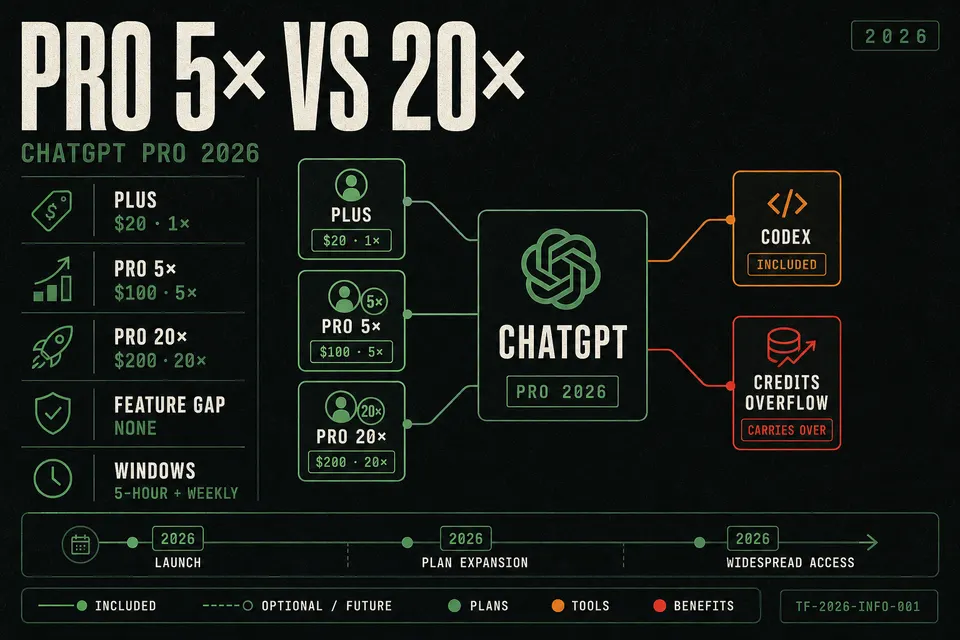
ChatGPT Pro $100 vs $200 explained: same Pro features, 5× vs 20× usage vs Plus. Compare rate limits, Codex headroom, and which tier fits you.
OpenAI sells ChatGPT Pro $100 vs $200 as the same product with different fuel tanks. The $100 tier is Pro 5×—five times Plus usage—while the $200 tier is Pro 20×, the highest individual capacity plan. For users already hitting Plus walls, the choice is headroom, not a different model suite. Anthropic frames its own plan the same way: Claude Max splits into 5x and 20x usage tiers at the same two price points.
Update — as of 10 September 2026, Pro $200 is closed to new buyers. OpenAI has temporarily paused new sign-ups and upgrades to the ChatGPT Pro $200 plan (Pro 20×), including sign-ups and upgrades from Free, Go, Plus or Pro $100. Existing Pro $200 subscriptions keep renewing as usual, and new or existing Pro $100 subscriptions are unaffected. OpenAI tied the pause to demand for GPT-6 Astra, its most capable model, which launched on 3 September 2026. In practice: Pro $100 is the only Pro tier you can enter today, and if a Pro $200 subscription ends for any reason—cancellation, downgrade, failed renewal or refund—it cannot be repurchased until the pause lifts. Read the tier comparison below with that constraint in mind.
Pricing snapshot: Plus, Pro 5×, and Pro 20×
| Plan | Monthly price | Official usage framing vs Plus |
|---|---|---|
| Plus | $20 | Baseline (1×) |
| Pro $100 | $100 | 5× higher usage than Plus |
| Pro $200 | $200 | 20× usage than Plus — paused to new buyers since 10 September 2026 |
OpenAI’s Help Center is explicit: both Pro tiers include the same core capabilities. The main difference is usage allowance: Pro $100 unlocks 5x higher usage than Plus, while Pro $200 unlocks 20x usage than Plus. The $200 plan remains the highest usage tier on paper; the $100 plan adds another option for users who want Pro capabilities with lower usage. While the pause holds, $100 is also the only option new buyers have.
Relative to Plus, the steps are clean. $20 → $100 is a 5× price step for a 5× capacity step. $20 → $200 is a 10× price step for a 20× capacity step. $100 → $200 doubles the bill and multiplies official capacity by four. Annual or multi-month prepay is not available for Go, Plus, or Pro.
Pro launched as a single $200 plan; the $100 tier arrived on 9 April 2026 as a mid-tier option, especially for Codex-heavy demand, without changing Pro’s role as a capacity product on shared Pro-grade access.
Ignore any lingering “10× Codex” framing from the $100 tier’s launch window. That was a promotion, it ran through 31 May 2026, and it is over. Steady-state is 5× and 20×.
How rate limits work
OpenAI does not publish a fixed “messages per day” guarantee for every model. Official framing is multipliers vs Plus, plus windows and per-model allowances.
Multipliers. Think in 5× and 20× relative to Plus. Some models carry separate allowances. When one is exhausted, that model can become temporarily unavailable until reset; ChatGPT may show a reset time. Hitting an allowance is not an account ban or subscription end—you can switch models or wait. The $100 tier has lower per-model allowances than $200.
Codex and agentic work. OpenAI’s Codex pricing docs express limits for Plus, Pro 5x and Pro 20x as estimated local messages per five-hour period, broken out per model. Local messages and cloud chats share your plan’s usage allowance, and weekly limits may also apply. A separate Codex-specific breakdown covers GPT-6 Astra, Sol and Luna message allowances by plan.
The five-hour window is not currently the Pro constraint. OpenAI removed the rolling five-hour cap in July 2026, then reinstated it on 25–26 August 2026 for Plus only, deliberately leaving it switched off on both Pro $100 and Pro $200 for the coming months. On Pro today, the weekly limit is the live ceiling. Be aware that OpenAI’s own pricing tables still print every range in five-hour language, so a reader checking the docs will see a framing the product is not currently enforcing on Pro. Separate cloud-task and code-review columns now survive only on the legacy Codex rate card, which most customers have been migrated off.
Usage depends on task size, complexity, model, local vs cloud, reasoning, tools, and context—not prompt count alone. Image generation burns included limits about 3–5× faster on average; speed-oriented modes also consume faster, and Fast mode on GPT-6 Astra is charged at 2.5× the Standard rate in Codex and ChatGPT Work. Live tables show range bands that scale with the official multipliers; those bands drift and are orientation, not a permanent quota.
After included limits. Plus and Pro can buy credits to continue without upgrading, or run extra local tasks against an API key at API rates. API billing and ChatGPT subscriptions remain separate. The break-even math between the ChatGPT API and a Plus subscription helps decide when that overflow path is worth it. With the $200 upgrade path closed, credits and an API key are the only overflow valves available to a Pro $100 subscriber. Temporary historical boosts around the $100 launch created multiplier confusion; current steady-state Help Center language is 5× and 20× vs Plus.
Feature parity: same Pro core, different headroom
Between $100 and $200, the upgrade is almost pure capacity, with one published exception.
Both tiers include the Pro model set and Pro package—Codex, deep research, image creation, memory, file uploads, and related tools. The exception is voice: unlimited ChatGPT Voice on desktop is a $200-only line item. OpenAI’s plan-dependent desktop Voice allowances run roughly 30 minutes–1 hour on Plus, about 3–6 hours on Pro 5× ($100), and unlimited on Pro 20× ($200). Unlimited voice does not make Codex tasks unlimited—tasks started through Voice still draw on your Codex usage budget.
GPT-5.3-Codex-Spark (research preview) was the other Pro-versus-Plus differentiator, and it is on its way out. OpenAI announced on 11 September 2026 that Spark would be retired the following week, citing declining usage and better models in the lineup. OpenAI’s pricing and model pages had not caught up at the time of writing and still list it as a Pro-only preview with a separate usage limit, so do not buy a Pro tier for it. Third-party “Pro exclusives” are otherwise generally Pro vs Plus distinctions, not a hidden gap between the two Pro prices. If a model feels missing on $100, the official explanation is usually a lower allowance, not a locked SKU.
How to switch and bill
- Entry: Pricing page or Settings → My Plan
- Upgrade (Plus → Pro $100): new limits apply immediately; billing cycle starts over
- Upgrade to Pro $200: unavailable while the pause that began 10 September 2026 holds—this includes upgrading from Pro $100
- Switch $200 → $100: takes effect at the end of your current billing cycle; you keep $200 until then and can undo it in billing settings before the cycle ends. Once it takes effect you cannot move back up until the pause lifts
- Downgrade (including Pro → Plus): effective at next renewal; keep current plan until then
- Cancel: access through period end; no renewal—but if a Pro $200 cancellation takes effect, you cannot repurchase $200 until the pause lifts
- Refund or promotion: if either ends a Pro $200 subscription, the same rule applies—no repurchase during the pause
- No annual plan for Go, Plus or Pro
Guardrails still ban automated extraction, account sharing, and reselling; temporary restrictions can appear with in-product notice.
Who should buy which tier
Stay on Plus ($20) if limits hit infrequently, waiting for a five-hour or weekly reset is fine, credits cover rare overflow, and you do not need sustained Pro-model or max Codex density. Plus is the tier that carries both a rolling five-hour cap and a weekly cap as of 26 August 2026.
Choose Pro 5× ($100) if Plus regularly dies mid-session, you need Pro capabilities without all-day multi-agent volume, a few weeks of use show 5× matches your bursts, and you accept lower per-model allowances than $200. This is the default for power knowledge workers and freelancers who lose billable time to walls but are not running continuous parallel agents. It is also, as of 10 September 2026, the ceiling available to new buyers—so treat it as a one-way door and plan overflow around credits or an API key rather than a later $200 upgrade.
Pro 20× ($200) is worth keeping if you already hold it and your work is continuous Codex, long-context sessions, and parallel agents—it is still OpenAI’s highest individual usage tier, and letting it lapse means you cannot get it back until the pause lifts. A deeper look at which tier actually fits continuous agentic Codex work breaks down that tradeoff further. You cannot newly buy it or upgrade into it right now. If 5× walls you today, the available moves are credits, a smaller model, serialised agents, or API-key overflow.
Before you pay: Log limit hits for 1–2 weeks (time of day, model, local vs cloud, context size). A practical playbook for tracking rate limits across ChatGPT, Claude and Cursor covers how to log that data cleanly. Prefer official 5× / 20× language over third-party absolute message counts or expired promo multipliers. Remember upgrade to $100 is immediate with a new cycle; downgrade waits for renewal. Re-check Help Center Pro tiers and live pricing tables before you buy—bands, model names and plan availability change, and three of them changed in the first two weeks of September 2026. Limits are dynamic and load-sensitive; fair-use and Terms always apply; API and ChatGPT are separate bills.
Bottom line
ChatGPT Pro at $100 and $200 is the same product with different tanks: Pro $100 unlocks 5× usage versus Plus; Pro $200 unlocks 20×; both share the same core Pro capabilities, with unlimited desktop Voice as the one $200-only extra. Since 10 September 2026 only the $100 tier is open to new buyers, so the practical decision is Plus versus Pro $100, with credits or an API key as the overflow valve instead of a $200 upgrade. Limits reset rather than cancel the plan: weekly caps are the live Pro ceiling, the reinstated five-hour window applies to Plus, and per-model allowances sit underneath both. Measure your limit hits for a couple of weeks, try credits for overflow, then buy the lowest multiplier that keeps work moving—not a higher price for the illusion of a different model suite.