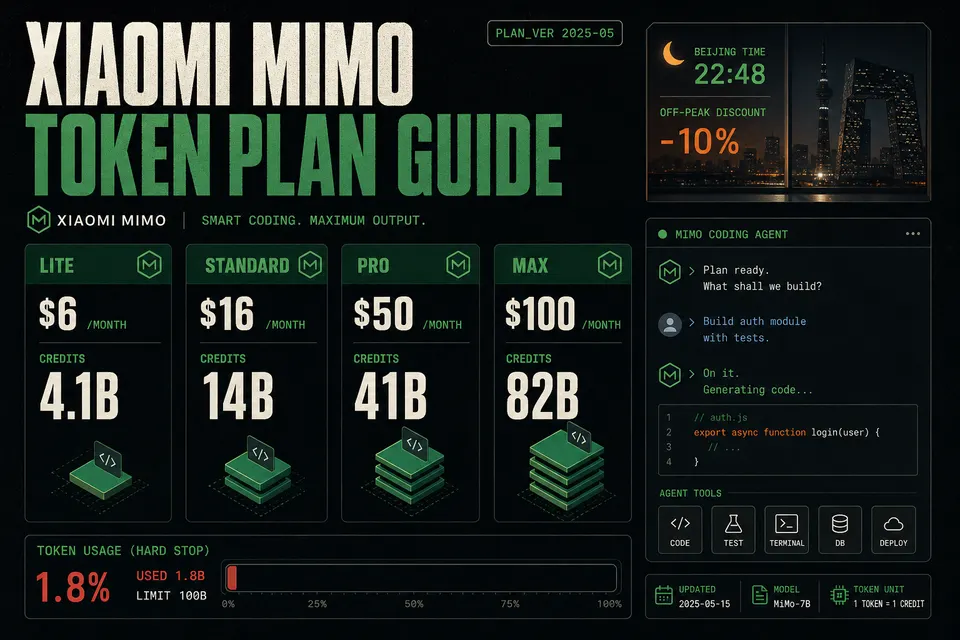
Xiaomi MiMo Token Plan Pricing: 2026 Tier Guide for Coding Agents
AK
Alex Kim Threat intelligence editor · Updated Jul 16, 2026, 4:15 AM EDT
MiMo-V2.6 lands on the same four credit tiers at unchanged prices and burn ratios, while mimo-v2.5 goes offline on 21 October 2026 — and a per-seat Team Edition now exists.
Xiaomi has pushed deeper into cloud AI coding with the MiMo Token Plan, a four-tier credit subscription that now powers the MiMo-V2.6 series inside agent toolchains such as OpenCode, OpenClaw, Claude Code and Codex-class environments. V2.6's benchmark story is covered separately in MiMo-V2.6's record CyberGym score and same-day MIT weights release. For engineering leads and individual developers who want predictable spend instead of opaque rate limits, the plan's fixed monthly or annual Credits, published burn ratios and hard stop-then-pay-as-you-go design are the main story—not free open-weight downloads.
Two dates matter. After a permanent commercial reset on 27 May 2026, Xiaomi cut API prices and lifted Token Plan usable volume roughly five- to eightfold at the same list prices. Then on 21 September 2026 the V2.6 generation landed and immediately became the plan's default. The tier prices did not move, the credits did not move, and the burn ratios did not move—but mimo-v2.5-pro and mimo-v2.5 are scheduled to go offline at 10:00 Beijing Time on 21 October 2026. Live documentation last updated 21 September 2026 is the baseline for every figure below.
What actually changed with V2.6
The commercially important answer is: less than the version number suggests, and the one thing that did change is a deadline.
Prices and credits are identical. Lite through Max still cost $6 / $16 / $50 / $100 a month for 4.1B / 11B / 38B / 82B credits.
Burn ratios carried over exactly.mimo-v2.6-pro bills at the old mimo-v2.5-pro rate; mimo-v2.6-flash bills at the old mimo-v2.5 rate. A team that modelled its spend in July does not need to remodel it.
Pay-as-you-go list rates are unchanged on the equivalent SKUs.
The naming changed shape. The cheap tier is now called Flash rather than a bare version string, which matters when a config file pins a model ID.
V2.5 has roughly 30 days left. Any toolchain, CI job or .env still pinning mimo-v2.5 or mimo-v2.5-pro starts failing after 21 October. This is the only urgent action item in the release.
A Team Edition now exists, which reverses the previous guidance for multi-developer shops (see below).
On capability, V2.6-Pro is a 1.02-trillion-parameter sparse mixture-of-experts model with about 42B active parameters at inference; V2.6-Flash is 310B total / 15B active. Both carry a 1 million token context window, accept text, image, audio and video, and emit up to 128K output tokens. Weights are MIT-licensed on Hugging Face, alongside a MiMo-V2.6-Pro-UltraSpeed variant and a distilled MiMo-V2.6-Distill-Qwen-9B. Xiaomi reports each model took 30 large RL steps over roughly 750,000 trajectories in under six days, at about $2.62M for Pro and $850K for Flash, and has released more than 7,000 RL task environments and an end-to-end RL framework.
Full pricing: monthly and annual
Tier
Monthly (USD / CNY)
Monthly credits
Official ~rounds (mimo-v2.6-flash, medium–complex)
Annual (USD / CNY)
Annual credits
Lite
$6 / ¥39
4.1B
~200
$63.36 / ¥411.84
49.2B
Standard
$16 / ¥99
11B
~1,600
$168.96 / ¥1,045.44
132B
Pro
$50 / ¥329
38B
~5,600
$528 / ¥3,474.24
456B
Max
$100 / ¥659
82B
~12,800
$1,056 / ¥6,959.04
984B
Annual prepaid equals exactly 12× monthly credits and is priced at about 88% of twelve continuous monthly list payments—roughly a 12% discount. Xiaomi positions Lite for first-time explorers, Standard for frequent efficiency users, Pro for daily professional agent work, and Max for high-intensity "AI as core productivity." Annual task volume is described as about 12× the monthly marketing rounds.
Note the baseline behind the rounds column: it is mimo-v2.6-flash, the cheap model. Earlier documentation quoted the same round counts against mimo-v2.5, which billed at the same ratio—so the numbers are comparable, but they have never described Pro-class usage.
Do not mix these figures with the original launch buckets (Lite 60M through Max 1.6B credits). Those pre-optimization numbers are obsolete for current purchasing decisions. Z.ai runs a comparable credit-tier model worth cross-checking: see the GLM Coding Plan's Lite, Pro and Max tiers.
Credits are not tokens: model burn rates
Billing is credit-based. Every supported model shares one package pool at different ratios: mimo-v2.6-pro, mimo-v2.6-flash, the outgoing mimo-v2.5-pro and mimo-v2.5, the ASR model mimo-v2.5-asr, and the TTS series. TTS is limited-time free and does not burn package credits. ASR costs 30 million credits per hour of input audio (second-accurate) and is not covered by the October language-model retirement.
Model
Input (cache hit)
Input (cache miss)
Output
mimo-v2.6-pro
2.5 credits/token
300
600
mimo-v2.6-flash
2
100
200
mimo-v2.5-pro(offline 21 Oct)
2.5
300
600
mimo-v2.5(offline 21 Oct)
2
100
200
Cache hits are orders of magnitude cheaper than misses and outputs. Official Lite example: 10 million cache-miss input tokens on a Pro-class model burn 3B credits, leaving roughly 1.1B on a 4.1B plan. ASR-only on Lite yields about 136.6 hours of audio per month (~4.5 hours/day).
Illustrative session math (approximate, not vendor-defined): a mid-size turn of ~20k cache-miss input + 5k output costs about 3M credits on Flash versus 9M on Pro. Model choice therefore moves cost more than tier choice, and it moves it by 3×. Long-context tool loops on Pro exhaust credits far faster than the marketing rounds imply. Community stress tests that report tens of millions of raw tokens on a $6 Lite plan are useful only if readers remember credits ≠ tokens.
C
Shared package pool
E
G
A
Hard stop
Upgrade by price difference
Pay-as-you-go API
Hard limits, exhaustion and pay-as-you-go
A package starts immediately. Monthly validity is purchase day plus 30 full calendar days to 23:59:59 UTC; annual is a calendar year from purchase. Only one package may be active. Upgrades are allowed by paying the price difference:
Price difference = New price − (Remaining / Total) × Original price
Downgrades are not supported. Refunds are not supported; unused credits are not refunded. Usage alerts fire at 50% / 90% / 100%. Auto-renew is available (Alipay, WeChat Pay, Xiaomi Pay domestically; Waffo or Stripe overseas) and can be cancelled anytime.
When credits or validity hit zero, service stops. Xiaomi's wording is that the system "will suspend the service and will not continue to deduct from your bonus or account balance"—there is no silent drain. Continue by upgrading the package or switching to the regular pay-as-you-go API. Approximate PAYG USD list rates:
Model
Input cache hit / MTok
Input miss / MTok
Output / MTok
MiMo-V2.6-Pro
$0.0036
$0.435
$0.87
MiMo-V2.6-Flash
$0.0028
$0.14
$0.28
ASR
—
—
~$0.074 / audio hour
A separate MiMo-V2.6-Pro-UltraSpeed SKU sits on the PAYG matrix at higher rates for latency-sensitive work.
Scope is strict in practice: package quota is sold for programming and agent tools, and the documentation frames compatibility around OpenCode, OpenClaw, Claude Code and similar toolchains. Using a package tp- key for non-coding automation or custom backends risks suspension or key ban. Keys and base URLs are region-specific (China, Singapore, Europe) with OpenAI- and Anthropic-compatible paths; all tools share one quota.
Night discount and prepay value
Off-peak window: Beijing 00:00–08:00 (UTC 16:00–24:00). Consumption coefficient: 0.8×—a 20% reduction in credit burn. Fully shifting work into that window stretches a package by up to one-fifth of effective capacity (timezone-dependent for global teams).
First purchase of a package receives 12% off, once per account; continuous annual is already ~12% off monthly list and does not stack the first-purchase promo the same way. Higher tiers improve list dollars per billion credits slightly; the night window improves work per dollar, not the sticker price.
Team Edition: the multi-seat answer that did not exist before
Earlier Token Plan documentation read as a developer product only, which made shared keys a ToS and ban risk and pushed teams toward multiple individual accounts or straight PAYG. That is no longer the guidance. A Team Edition is now published, priced per seat at the same list as the individual tiers:
Team tier
Per seat, monthly (USD / CNY)
Per seat, annual (USD / CNY)
Credits per seat, monthly
Standard
$16 / ¥99
$168.96 / ¥1,044
11B
Pro
$50 / ¥329
$528 / ¥3,468
38B
Max
$100 / ¥659
$1,056 / ¥6,948
82B
There is no Lite at team level. The published pages do not state a seat minimum or maximum, and they do not say whether credits pool across the team or stay pinned per seat—which is the single most important number for a team with uneven usage, and worth confirming with sales before committing. Teams that built a workaround out of multiple personal accounts should revisit it; teams that stayed on PAYG purely for the seat problem now have a listed alternative.
Competitive context
Western coding agents typically sell seat subscriptions with rate or session ceilings. Claude individual coding access commonly sits around $20/month (Pro) and $100–$200/month (Max-class tiers). MiMo's published edge is arithmetic transparency: fixed credits, explicit Pro versus Flash multipliers, hard stop, night 0.8×, and a clean PAYG escape hatch.
V2.6 strengthens the capability half of that argument. On Artificial Analysis' Intelligence Index, MiMo-V2.6-Pro scores 46, the top open-weights model, tied with Grok 4.7 and ahead of Grok 4.6 (44), Gemini 3.8 Flash (41) and DeepSeek V4.1 Flash (39). On Xiaomi's own agent evaluations, Pro and Flash land close together—DeepSWE v1.1 71.9 / 67.9, Terminal Bench 2.1 89.9 / 87.6, AutomationBench 53.1 / 52.3, CyberGym 94.0 / 95.1—which is the more commercially interesting result, because Flash bills at a third of Pro's rate for a few points of benchmark.
The ceiling is still real: Anthropic's Claude Opus 5 remains ahead on several evaluations including DeepSWE v1.1, ProgramBench and Terminal Bench 4.0, at $5.00 / $25.00 per million tokens against Pro's $0.435 / $0.87; GPT-5.6 Sol lists at $5.00 / $30.00. That is roughly an order of magnitude of price gap to weigh against a handful of benchmark points, and vendor-run agent benchmarks deserve the usual discount.
Capability, latency, tool reliability and data residency are not settled by price tables. Some teams still prefer higher-priced Western agents for production reliability, while cost-sensitive shops use MiMo for volume agent loops. Neither is MiniMax's rival structure, covered in MiniMax's Plus, Max and Ultra token plan comparison. Open-weight MiMo-V2.6 releases remain a separate CapEx path; Token Plan is the managed, coding-oriented cloud subscription.
Who should buy which tier
Profile
Starting tier
Rationale
Solo explorer / weekend agents
Lite ($6)
Low risk; upgrade by price difference
Daily pair-programming, mostly Flash
Standard ($16)
Official efficiency band, 11B credits
Full-time agentic coding, frequent Pro
Pro ($50)
Daily professional band, 38B credits
All-day agents / heaviest pool
Max ($100) or annual Max
Highest credits; best list $/B
APAC / night batch jobs
Any + Beijing 0–8 load
0.8× burn
Year-round predictable budget
Annual of chosen tier
~12% off + 12× credits
Multi-developer shop
Team Edition Standard and up
Per-seat, no more shared-key ToS risk
Non-coding backends / high variance
Avoid Token Plan → PAYG or self-host
Coding-oriented scope rule
Privacy / owned multi-GPU
Open weights first; Token Plan for burst UX
Separate product paths
Bottom line for stack decisions
MiMo Token Plan is a numbers-first coding-agent subscription at $6–$100/month (annual roughly 12% cheaper) with 4.1B–82B monthly credits, a hard stop into upgrade or pay-as-you-go, and night 0.8× stretch for Beijing off-peak work. V2.6 arrived without moving any of those numbers, which is the best possible outcome for anyone who already budgeted against them. That transparency-first pitch is common across the field; see how Chinese labs are reinventing coding-agent token pricing.
The action item is narrower than a launch post suggests: repin your model IDs before 21 October 2026, when mimo-v2.5 and mimo-v2.5-pro go offline, and default to Flash rather than Pro unless a workload demonstrably needs the larger model—that single choice is a 3× swing in burn. Teams should re-evaluate the new per-seat Team Edition against whatever multi-account workaround they built. For CTOs comparing Claude Max-class or Codex-class spend, the plan belongs on the shortlist for transparent quota math—provided quality and reliability are validated against the workloads that actually matter. For the full field of options from $6 to $300, see the complete individual AI subscription decision matrix for solo developers.