Arista VeloCloud Orchestrator Zero-Day CVE-2026-16812 Demands Active Threat Hunting and Management Isolation
AK
Alex Kim Threat intelligence editor · Updated Jul 28, 2026, 3:52 AM EDT
Critical CVSS 10.0 zero-day CVE-2026-16812 hits Arista VeloCloud Orchestrator. Learn how to hunt for active exploits, patch versions, and isolate management…
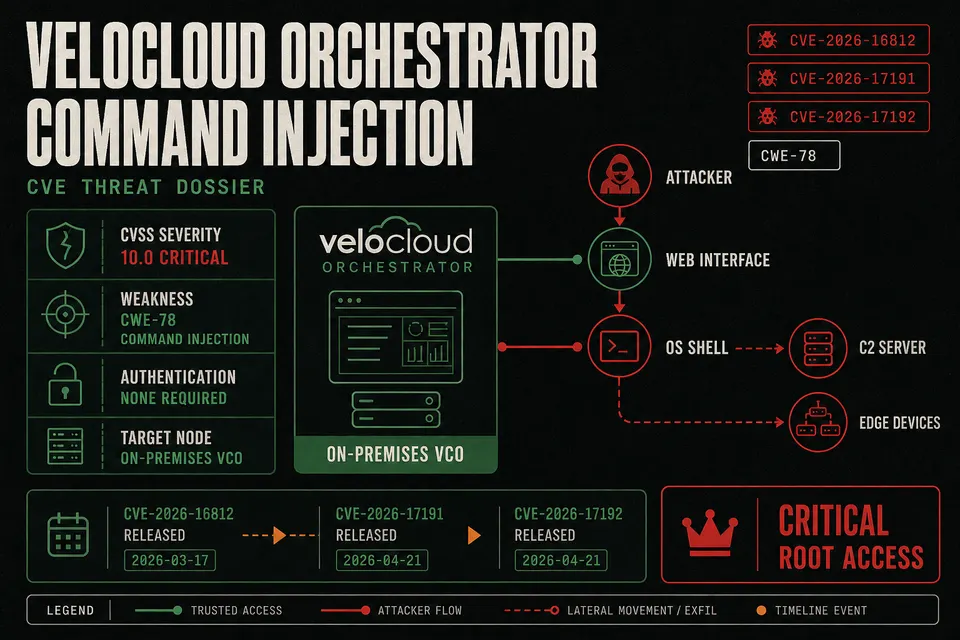
The discovery of active zero-day exploitation targeting on-premises Arista Networks VeloCloud Orchestrator deployments has shifted enterprise risk from routine vulnerability patching to an urgent threat-hunting imperative. Tracked as CVE-2026-16812, the maximum-severity flaw carries a CVSS 10.0 (Critical) score under both CVSS v3.1 and CVSS v4.0 metrics (AV:N/AC:L/PR:N/UI:N/S:C/C:H/I:H/A:H). The vulnerability stems from an unauthenticated OS command injection weakness (CWE-78) within internal management functions. Because the flaw allows remote, unauthenticated attackers to execute arbitrary system commands with complete administrative privileges over exposed Orchestrator nodes, federal cyber authorities have designated the vulnerability for mandatory emergency remediation.
B
Root / Application OS Shell
Compromised Management Plane
Malicious Attacker Infrastructure
Unauthenticated Remote Attacker] -->|HTTP/HTTPS Request| B[Exposed On-Prem VCO Web Interface
Technical Anatomy of CVE-2026-16812 Command Injection
The root mechanism of CVE-2026-16812 resides in a vulnerable internal management endpoint designed exclusively for local system operations. During initial product assembly, this endpoint was bundled into the main web application stack without restricting network accessibility or enforcing session authentication. Consequently, any network path capable of delivering HTTP or HTTPS traffic to the VeloCloud Orchestrator (VCO) web management interface provides an unauthenticated vector for command injection.
Crucially, no native product configuration toggle exists within vulnerable software releases to disable access to this internal endpoint. The flaw affects four major enterprise release trains, while cloud-hosted and dedicated cloud instances were patched prior to public disclosure.
Software Release Train
Vulnerable Version Range
Remediated Release
Vulnerability Status
VeloCloud Orchestrator 5.2.x
Versions prior to 5.2.3.14
5.2.3.14
Unauthenticated Zero-Day (Exploited)
VeloCloud Orchestrator 6.1.x
Versions prior to 6.1.3.4
6.1.3.4
Unauthenticated Zero-Day (Exploited)
VeloCloud Orchestrator 6.4.x
Versions prior to 6.4.2.4
6.4.2.4
Unauthenticated Zero-Day (Exploited)
VeloCloud Orchestrator 7.0.x
Versions prior to 7.0.0.1
7.0.0.1
Unauthenticated Zero-Day (Exploited)
Critical Risk Note: Legacy versions of VeloCloud Orchestrator at End-of-Support (EOS) were not evaluated. Organizations running legacy builds must treat those instances as vulnerable and immediately upgrade to supported release trains.
Defenders should also address companion maintenance vulnerabilities resolved in the same patch cycle, including CVE-2026-17191 (CVSS 9.1, SQL injection in the Flow Metrics API) and CVE-2026-17192 (CVSS 8.5, Server-Side Request Forgery). While these secondary flaws require prior authentication, deploying the consolidated update resolves the entire attack surface.
Forensic Playbook: Inspecting Orchestrator Access Logs and System Artifacts
Because public exploitation began prior to patch availability, enterprise security operations centers must conduct retrospective threat hunting across all on-premises Orchestrator nodes. Initial access attempts leave distinct traces across web access logs, API gateway logs, and operating system audit records.
Threat hunters should query web server access logs for command separators, subshell expansions, or URL-encoded payloads inserted into URIs and POST parameters.
# Search Nginx/Apache web access logs for shell injection syntax and known IP IOCs
grep -E '(8\.19\.75\.217|206\.72\.242\.124|206\.72\.242\.162)' /var/log/nginx/access.log

# Scan web logs for command separator characters and system binary references
egrep -i '(%20|%0a|%0d|\|\|\;|\`|\$\().*(wget|curl|python|bash|sh|nc|tftp|certutil)' /var/log/nginx/*access*.log
Incident response teams should cross-correlate four primary data sources to confirm post-exploitation activity:
VCO Web Access Logs: Examine incoming HTTP verbs, payload lengths, and client IP addresses for requests targeting internal endpoints.
Backend Application Logs: Identify runtime exceptions, unexpected subprocess invocations, or abnormal API queries originating from local host processes.
OS Audit Logs (/var/log/audit/audit.log, /var/log/syslog): Look for process creation events (execve) where web server processes spawn shell interpreters (/bin/sh, /bin/bash).
Database Access Logs: Review queries exporting tenant inventories, API tokens, cryptographic certificates, or site-to-site VPN keying material.
Indicators of compromise identified in active threat campaigns include suspicious inbound traffic from primary malicious hosts:
Indicator Type
Value / Hash / Descriptor
Context & Threat Activity
IPv4 Address
8[.]19[.]75[.]217
Inbound exploit delivery and reconnaissance
IPv4 Address
206[.]72[.]242[.]124
Primary C2 and payload retrieval server
IPv4 Address
206[.]72[.]242[.]162
Secondary scanning and command execution host
MITRE ATT&CK
T1059.004 (Unix Shell)
Post-exploitation command execution
MITRE ATT&CK
T1190 (Exploit Public-Facing Application)
Initial access via unauthenticated endpoint
Forensic Guidance: Post-exploitation indicators include unauthorized file placement in web directories, scheduled job creation in /etc/cron.*, and outbound persistent TLS connections from Orchestrator host IPs toward external command-and-control nodes.
Remediation Beyond Patching: Restricting Management Planes and Network Segmentation
Deploying vendor updates eliminates the code vulnerability, but durable defense requires structural isolation of the SD-WAN management plane. Enterprise architectures must enforce strict separation between management controllers, control-plane signaling, and user data-plane transit.
MgmtVLAN
Patched VeloCloud Orchestrator
Untrusted Enterprise Networks] -->|Blocked at Perimeter Firewall| AccessList[Strict IP Access Control List
To secure on-premises Orchestrator instances against future zero-day vectors, network infrastructure teams must implement four core controls:
Out-of-Band Management Isolation: Move the VCO web interface off general enterprise networks into a dedicated Out-of-Band (OOB) management VLAN accessible only via Zero-Trust Network Access (ZTNA) gateways or jump hosts.
Strict Inbound Access Control Lists (ACLs): Apply hardware firewall filters restricting inbound TCP ports 80 and 443 strictly to trusted administrative IP ranges.
Egress Traffic Filtering: Restrict outbound host connections to verified update repositories and threat intelligence feeds.
Interactive Shell Hardening: Enforce multi-factor authentication for SSH sessions and route system administrative commands through privileged access management platforms.
Long-Term Governance for Enterprise SD-WAN Controllers
Maintaining operational continuity while isolating a compromised management plane presents a key operational challenge. Fortunately, VeloCloud SD-WAN architecture decouples the control and management planes from the data plane.
When a VeloCloud Orchestrator node is isolated or powered down for forensic investigation, underlying VeloCloud Edge devices continue forwarding data-plane traffic over established overlay tunnels without interruption. This architectural independence allows incident response teams to quarantine a suspect Orchestrator without disrupting branch WAN connectivity.
Security teams should follow an automated incident recovery workflow when responding to potential management plane compromise:
# Incident Response Protocol: SD-WAN Management Plane Quarantine
def execute_orchestrator_isolation(instance_id):
 # Step 1: Capture non-volatile forensic memory and disk snapshots
 capture_forensic_snapshot(instance_id)

 # Step 2: Restrict network interface to forensic collection VLAN
 reassign_network_vlan(instance_id, target_vlan="ISOLATION_FORENSICS_ONLY")

 # Step 3: Verify branch data plane continuity across active Edges
 status = check_edge_data_plane_status()
 if status == "STABLE_FORWARDING":
 # Step 4: Provision clean, parallel Orchestrator instance from trusted media
 deploy_parallel_orchestrator(version="7.0.0.1")
 # Step 5: Rotate root certificates, API tokens, and Edge credentials
 rotate_infrastructure_secrets()
To ensure long-term resilience, organizations must integrate SD-WAN controllers into automated vulnerability scanning routines, enforce configuration drift detection, and execute routine failover drills. Combining rapid patching with zero-trust network isolation ensures single-point software vulnerabilities cannot compromise broader enterprise operations.